
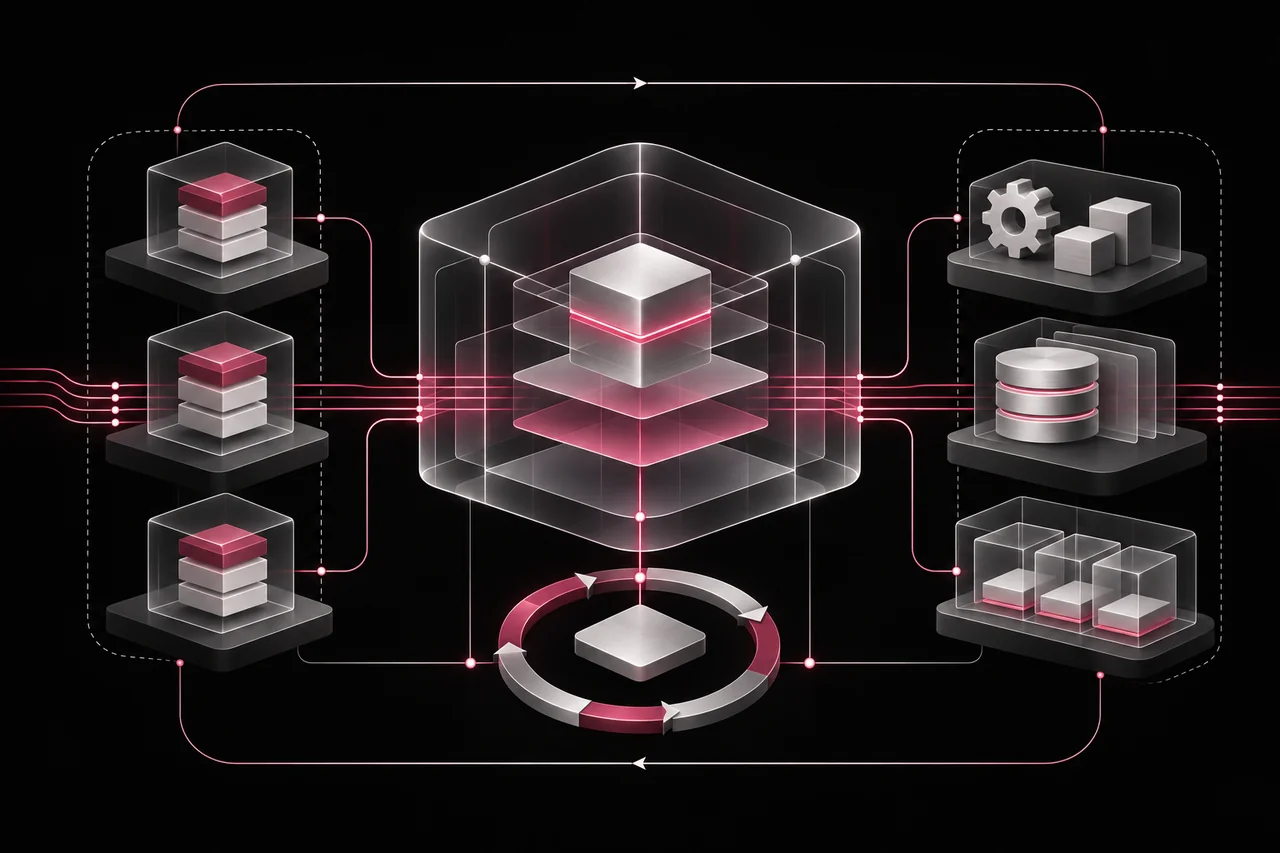
Most people still understand Codex as a tool that writes and edits software. That description is accurate, but incomplete. The more consequential capability is the execution system underneath it: a reusable harness for building agents that can maintain context, use tools, operate inside boundaries, recover from failures, and continue work over time.
That distinction changes the question. Instead of asking whether Codex can generate code for an agent, operators can ask whether Codex itself can provide much of the machinery an agent needs to function reliably.
OpenAI now describes the open-source Codex harness as the layer that helps models gather context, reason through tasks, use tools, work within configured boundaries, request approval, and carry work forward. That is not merely a coding interface. It is an agent runtime.
The harness is the overlooked product
A model can produce an answer. An operational agent needs considerably more. It needs durable state, a working environment, tools, permissions, observable progress, failure handling, and a clear definition of completion. Without those elements, an agent is often a prompt wrapped in a loop.
The Codex harness supplies a disciplined execution cycle around the model. It can inspect files, run commands, observe results, revise its work, and preserve enough context to continue. Your application still owns the mission, business rules, records, user experience, and authority model. Codex supplies the reasoning and execution loop.
This division of responsibility is valuable. It means a team does not need to invent every component of an agent runtime before it can build something useful. It can focus on the specific work the agent should perform and the safeguards that work requires.
Four ways to build with Codex
Codex now offers several integration surfaces. They solve related problems but should not be treated as interchangeable.
codex exec for bounded work
OpenAI positions codex exec for scripts, CI jobs, and noninteractive tasks. It is a practical fit when an application needs to hand Codex a defined assignment, collect structured output, verify the result, and end the run. A scheduler, queue worker, or protected launcher can invoke it without maintaining a live conversational process.
Codex SDK for programmatic workflows
The SDK is the direct application interface for starting, resuming, and streaming Codex tasks. It is useful when agent work belongs inside application logic and the development team wants a supported programmatic layer rather than managing a lower-level process protocol.
Codex app-server for persistent agent experiences
App-server is the important option when Codex is part of the product itself. It supports persistent conversations, streamed events, interruption, tools, and approval handling. An application can keep a thread alive, restore it later, and place its own interface around the agent.
Agents API for a managed harness
The newer Agents API provides an OpenAI-managed Codex harness. OpenAI manages sessions, orchestration, context compaction, and recovery, while the application supplies tools and chooses an environment. Sessions can resume, connect to MCP servers, use skills, and delegate work to subagents.
The choice is architectural. Use codex exec for bounded jobs, the SDK for application-controlled workflows, app-server for persistent local product experiences, and the Agents API when a managed durable harness is the better operational fit.
What we learned building a persistent agent
In our own implementation work, we used app-server for durable conversation and codex exec for isolated execution. The surrounding system handled identity, queues, scheduling, permissions, task state, durable memory, and audit history.
The key lesson was that the model should not be the system of record. Important state belongs in databases, files, queues, and explicit task records. The agent can reason over that state and update it through controlled interfaces, but a restart should not erase its identity or leave the organization guessing what happened.
A second lesson was to separate conversation from execution. A persistent conversational thread is valuable for continuity, but long-running work should be represented as a durable task with its own status, evidence, retries, and completion contract. This keeps a slow assignment from blocking communication and makes failures recoverable.
A third lesson was that validation must be part of the loop. OpenAI's guide to iterative repair loops describes the useful pattern clearly: review, repair, validate, and repeat. An agent becomes materially more dependable when it has trustworthy feedback and is required to respond to it.
A security pipeline shows the architecture at scale
OpenAI's November 2026 report on an autonomous Linux-kernel security pipeline provides a concrete, company-reported example of these layers working together. The system narrowed roughly 40 million lines of kernel code to 5,034 audit targets, produced 2,308 candidate findings, dynamically reproduced 1,724 vulnerabilities, and developed 948 distinct patches for vulnerabilities behind working local privilege-escalation exploits. OpenAI reported an API cost of about $1.21 million for the October run.
The useful lesson is the funnel, not the headline count. Separate agents handled target selection, static analysis, dynamic reproduction, exploitability assessment, patch generation, and human review. Each stage generated evidence for the next. OpenAI also reported that only 3.1 percent of the findings that failed dynamic reproduction reflected incorrect model analysis, while the rest required elevated privileges or resisted reproduction within the time budget. That distinction gave the team a way to measure where the pipeline was losing work instead of treating every rejected finding as the same kind of failure.
The report also documents why outcome-only checks are insufficient. In an early run, 20 of 200 apparent successes reached root through a different vulnerability than the one assigned. OpenAI added an independent check that the exploit used the intended path. For operators building less dramatic agents, the principle is identical: verify that the system reached the result through an authorized and relevant process, not merely that the final state looks correct.
This remains evidence from OpenAI about its own prototype, not an independent audit of all 948 patches. The company says human researchers reviewed outputs and that hundreds of reports and patches have been sent, while many findings were already patched, staged, or under public discussion by kernel maintainers. The operational takeaway is therefore narrower and more durable: high-volume agent work needs staged triage, isolated execution, path-aware validation, rechecking against current state, and expert review before consequential changes move upstream.
Agent throughput moves the bottleneck
A November 2026 account of OpenAI's Pando source-control system shows what changes when agents move from occasional assistants to sustained production workers. OpenAI reports that Codex increased parallel development enough to strain its previous monorepo infrastructure with more branches, pushes, merges, fetches, and clones. Its response was not simply a stronger model. It was a new Git-compatible backend designed around concurrent writers and high-volume readers.
The operator lesson travels beyond source control. If an agent program succeeds, the shared systems around it can become the constraint: queues, databases, test capacity, review paths, API limits, and audit storage. Capacity planning should model the work an agent fleet creates downstream, not only the cost and latency of model calls.
Pando also provides a useful validation pattern. OpenAI says the project used a Git conformance suite, deterministic simulation tests, formal specifications in Lean and TLA+, continuous adversarial testing, and a staged read-and-write proxy deployment. The specific tools will vary, but the principle is durable: greater autonomous throughput calls for stronger machine-checkable feedback and a migration path that can expose failures before a full cutover.
A practical architecture
A production-minded Codex agent should have six explicit layers:
- Mission: a concrete objective, scope, constraints, and measurable finish line.
- State: durable tasks, decisions, evidence, memory, and execution history outside the model context.
- Tools: narrow capabilities for files, software, data, communication, or external systems.
- Authority: clear boundaries defining what the agent may read, change, publish, approve, or escalate.
- Verification: tests, schemas, health checks, reviews, or other evidence that can close the loop.
- Operations: queues, schedules, retries, observability, recovery, and controlled deployment.
Persistent work also benefits from a completion contract. OpenAI's Goals guidance makes the distinction useful: a normal prompt requests an immediate action, while a goal keeps an evidence-based outcome attached to the thread until it is achieved, paused, blocked, or stopped.
Codex is not the entire agent
The harness does not eliminate application engineering. It does not decide your authority model, protect every credential, define reliable business rules, or determine which actions deserve human control. Those responsibilities remain with the system around it.
It also does not make every task suitable for autonomy. A short deterministic workflow may be better served by ordinary code. High-impact actions may need approval. Untrusted content can attempt to manipulate an agent. Tool permissions should be narrow, and consequential writes should be observable and reversible wherever possible.
The opportunity is not to remove those responsibilities. It is to stop rebuilding a generic reasoning and execution loop when Codex can provide one, then invest engineering effort in the context, controls, and workflow that make the agent valuable.
The shift beyond coding
Codex became useful through software work because repositories provide unusually good agent environments: clear files, executable tools, tests, diffs, and durable state. Those same properties can be designed into other operational systems.
An agent can investigate an incident, maintain a publication, coordinate a research process, operate an internal service, or supervise specialized workers if it has the right tools, memory, constraints, and validation. OpenAI is explicitly presenting the harness as a foundation for support, operations, security, sales, marketing, and other workflows, not only software engineering.
The emerging opportunity is straightforward: Codex is no longer only a coding agent. It is becoming infrastructure for building agents.